University of Wisconsin–Madison

Capstone Certificate: Polymer Processing & Manufacturing (Online)
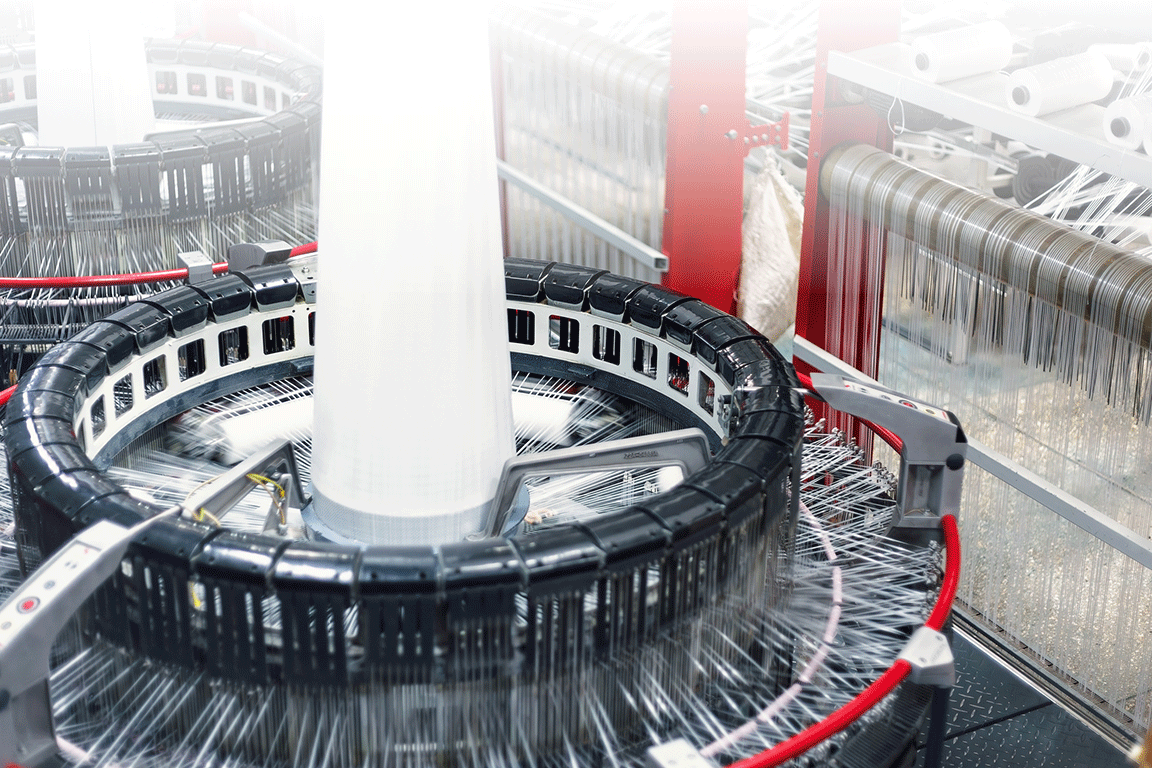
plastics manufacturing plant
Strengthen your understanding of polymer materials, processing methods, and manufacturing considerations.UW–Madison’s online Capstone Certificate in Polymer Processing and Manufacturing is designed for engineers who work with plastics, composites, elastomers, or polymer-based components. Courses are flexible and fully online, allowing you to develop applied polymer engineering skills while continuing full-time professional work.

How to ApplyRequest Info

Certificate awardedCapstone Certificate in Polymer Processing and Manufacturing
Credits9 graduate credits
Format100% Online, part-time
Duration9-12 months (part-time)
Tuition$1,100/credit Wisconsin residents receive an automatic $100 per-credit scholarship. Learn more.
StartFall / Spring / Summer
Application DeadlinesSpring: December 1 Summer: June 1 Fall: August 1

Is This Program Right for You?

The Capstone Certificate in Polymer Processing & Manufacturing is ideal for engineers and professionals looking to deepen their knowledge of polymer fabrication and materials behavior. Whether you’re seeking advancement or preparing for a master’s degree, this stackable credential fits your goals and your schedule.
  • Study polymer fabrication and processing with expert instructors
  • Learn in a flexible, interactive online format for working professionals
  • Build skills you can apply immediately to manufacturing and design challenges
  • Apply certificate credits toward the Master of Engineering in Polymer Engineering

How to ApplyRequest Info

Our courses blend applied activities, structured opportunities for interaction, and recorded instructor materials. This intentional design supports strong engagement, clear guidance, and meaningful results.

Why This Program?

27 years

of delivering interactive online education, reflecting deep experience designing high-quality online programs for working professionals.

#11 ranking

Online Graduate Engineering Programs U.S. News & World Report, 2026

Student Experience

Through courses in fabrication, simulation, and sustainability, you’ll explore how materials perform — and how to make them better. This capstone helps you solve real challenges in polymer and plastics processing, while preparing you for advanced study.
  • Principles of polymer processing and rheology
  • Material behavior and fabrication strategies
  • Techniques in molding and additive manufacturing
  • Simulation and modeling of polymer systems
  • Composite materials and transport phenomena
  • Approaches to sustainability and recycling
  • Design for manufacturability
  • Preparation for further graduate-level work

Curriculum and Requirements

Complete 9 graduate credits from among a selection of courses designed by leaders in the field of polymer engineering and science.Live course web sessions are scheduled in the evening to accommodate working professionals. All other weekly assignments can be completed on days and times of your choice. Plan for roughly 3 to 4 hours of work per credit each week. For a 3-credit course, this usually means 9 to 12 hours, depending on the course and your professional background.

EPD 634 — INTRODUCTION TO POLYMER CHEMISTRY2 credits.Introduction to the chemistry of polymeric materials. Concepts of polymer chemistry and synthetic methods are introduced. Knowledge of introductory general chemistry and thermodynamics [such as CHEM 104] required.Requisites: Graduate/professional standing or declared in Capstone Certificate in Polymer Processing & Manufacturing
EPD 636 — INTRODUCTION TO POLYMER PHYSICS2 credits.Introduction to the physics of polymeric materials. Concepts of polymer physical properties are introduced; including molecular weight, chain conformation, solution thermodynamics, the glass transition, crystallinity, basic rheology and viscoelasticity. Knowledge of introductory general chemistry and thermodynamics [such as CHEM 104] required.Requisites: Graduate/professional standing or declared in Capstone Certificate in Polymer Processing & Manufacturing
EPD 638 — POLYMER COATINGS & ADHESIVES3 credits.Introduction to coatings and adhesives, with a focus on the polymer science and chemistry underlying these materials. Topics include film formation, adhesion mechanisms, material characterization, application techniques, and the role of additives in common formulations.Requisites: Graduate/professional standing or declared in Capstone Certificate in Polymer Processing & Manufacturing
EPD 639 — PLASTICS RECYCLING & SUSTAINABILITY2 credits.Examine sustainability and recycling practices for plastics and polymeric materials, including textiles. Analyze environmental impacts and plastic waste using life cycle assessment. Explore traditional and emerging recycling technologies, along with bio-based and degradable plastics. Critically evaluate media coverage to identify “greenwashing” and improve understanding of sustainability issues.Requisites: E P D 634 or 636
EPD 640 — INTRODUCTORY POLYMER RHEOLOGY3 credits.Introduction to polymer rheology. Concepts of continuum mechanics are introduced, specifically the fluid dynamics of non-Newtonian and linear viscoelastic fluids. Material functions, constitutive equations and rheometry and experimental methods for measuring material functions (rheometry) are discussed. Knowledge of linear differential equations [such as MATH 319 or 320] and fluid mechanics [such as M E 363] or momentum transfer [such as CBE 320] required.Requisites: Graduate/professional standing or declared in Capstone Certificate in Polymer Processing & Manufacturing
EPD 648 — PLASTICS MANUFACTURING & SUSTAINABILITY SEMINAR1 credit.Topics in sustainability and recycling concerns in plastics manufacturing.Requisites: E P D 634 or 636
EPD 650 — INTRODUCTION TO POLYMERS PROCESSING3 credits.Introduction to the principles of polymer processing. Review of the basic techniques primarily in use by industry as well as foundational principles of polymer physics, viscoelasticity and rheology. Focus on understanding how design of process is used to achieve desired structure and properties. Includes introduction to topics such as 3-d printing and recycling of polymer waste in the context of reprocessing such materials.Requisites: E P D 636 and (E P D 640 or CHEM/​M S & E 421, or concurrent enrollment), or declared in Capstone Certificate in Polymer Processing & Manufacturing
EPD 652 — QUANTITATIVE METHODS FOR INTERDISCIPLINARY ENGINEERING3 credits.Review of topics for engineering applications, including vector calculus, differential equations, linear algebra, complex analysis, Laplace and Fourier transforms, optimization, and numerical methods.Requisites: Graduate/professional standing
ME 417 — TRANSPORT PHENOMENA IN POLYMER PROCESSING3 credits.Description of the physical, thermal, mechanical, and rheological properties of polymeric materials relevant to their processing behavior. Review of the basic transport phenomena equations: mass, momentum, and energy. Analysis of various processing operations for the manufacture of polymeric articles, with particular emphasis on: extrusion, injection molding, blow molding, thermoforming, compression molding and additive manufacturing. Discussion of plastics recycling and environmental issues.Requisites: Senior standing or member of Engineering Guest Students
ME 418 — ENGINEERING DESIGN WITH POLYMERS3 credits.Implications for plastics part design of polymer classification, structure, melt rheology, mixing, polymer blends, anisotropy, solidification, mechanical behavior, failure. Plastics design for electrical, optical, acoustic and barrier properties.Requisites: Senior standing, declared in Capstone Certificate in Polymer Processing & Manufacturing, or member of Engineering Guest Students
ME 419 — FUNDAMENTALS OF INJECTION MOLDING3 credits.All major aspects of injection molding with emphases on materials, design, processing, process physics, computer-aided engineering (CAE), troubleshooting, and advanced molding processes.Requisites: M E 310, M S & E 331, CHEM/​M S & E 421, member of Engineering Guest Students, declared in Capstone Certificate in Polymer Processing and Manufacturing, or graduate/professional standing
ME 514 — POLYMER ADDITIVE MANUFACTURING3 credits.A quantitative and qualitative study of additive manufacturing processes. Emphasis on proper additive manufacturing technique selection for optimized final product design and properties, as well as presentation of emerging additive manufacturing techniques.Requisites: Senior standing and (M E 310 or 313), graduate/professional standing, member of Engineering Guest Students, or declared in Capstone Certificate in Polymer Processing and Manufacturing
ME 717 — ADVANCED POLYMER PROCESSING3 credits.Advanced analysis and modeling of plastics extrusion, injection molding, and other processes; mold and equipment design; materials consideration. Knowledge of polymer processing [such as M E 417] strongly encouraged.Requisites: Graduate/professional standing or declared in Capstone Certificate in Polymer Processing and Manufacturing
ME 718 — MODELING & SIMULATION IN POLYMER PROCESSING3 credits.This course is designed to acquaint the student with computer simulation technology used for the engineering of polymer processes. Knowledge of polymer processing [such as M E 417] strongly encouraged.Requisites: Graduate/professional standing or declared in Capstone Certificate in Polymer Processing and Manufacturing

Tuition and Financial Aid

$1,100 per credit, payable at the beginning of each semester. Wisconsin residents receive an automatic $100 per-credit scholarship.* Students are responsible for paying their tuition bill in full by the due date. The scholarship is credited to their student account after the semester’s drop deadline and before the start of the next semester. There is no lump-sum payment plan.*Wisconsin resident tuition scholarship does not apply to students with tuition waivers.See Tuition & Cost for more information.
Employer Support Many students receive some financial support from their employers. Often, students find it beneficial to sit down with their employer and discuss how this program applies to their current and future responsibilities. Other key points to discuss include how participation will not interrupt your work schedule.

Admissions and Events

|

All applicants must:
  • Have a Bachelor of Science in engineering or a related STEM field such as Chemistry, Physics, Biochemistry, or Food Science from an accredited institution.
  • Have a minimum undergraduate GPA of 3.0 on the last 60 semester hours of coursework.
  • Submit evidence of English language proficiency, if applicable. See the Graduate School Requirements for more information.
  • GRE is not required. Applicants who have taken the test are encouraged to submit their scores.
The admissions committee considers exceptions to standard requirements on an individual basis.

  • Online application
  • Resume/CV
  • Transcripts
  • Optional: Two letters of recommendation.
For complete application details visit UW–Madison’s Guide 

Application Deadlines by Term:

Summer 2026June 1, 2026
Fall 2026August 1, 2026
Spring 2027December 1, 2026
Online Graduate Programs Overview Tuesday, September 8, 2026 5-5:30 PM CTJoin program staff for a conversation about our online graduate programs, including curriculum, application process and career impact.Register Now
Program Overview: Engineering: Polymer Engineering MEng Thursday, October 8, 2026 12-12:30 PM CTGet more information about the Engineering: Polymer Engineering MEng including curriculum, application process and potential career paths.Register Now
Online Graduate Programs Overview Tuesday, October 13, 2026 12-12:30 PM CTJoin program staff for a conversation about our online graduate programs, including curriculum, application process and career impact.Register Now

Faculty and Staff

Nicole Zacharia, PhD Program Director

Nicole Zacharia Email Nicole

Karene Cary Graduate Student Advisor

Email Karene

FAQ

|

A: Yes. The Capstone Certificate in Polymer Processing & Manufacturing is 100% online and designed for working professionals.

A: Most students finish in about three to four semesters while working full time, typically taking 1 to 2 courses per semester.

A: Tuition is charged per credit. See Tuition & Fees for more information.

A: Yes. Courses are designed for part-time study alongside a full-time job.

A: All credits from this program transfer to the online Polymer Engineering M.Eng. degree program. Some credits may be eligible to apply toward other UW-Madison online engineering master’s programs; contact the program office for details.

A: Submit your application through our Professional Degrees & Certificates site. See Admissions for details or click here.

Ready to lead with confidence? Advance your career with UW–Madison’s online MEng in Polymer Engineering.

How to ApplyRequest Info

Stay connected on LinkedIn Join our community of engineers, alumni, and faculty. Follow us for program news, upcoming events, and leadership insights.

Explore Similar Programs

Polymer Engineering header

Advance your career with UW–Madison’s online master’s in Polymer Engineering. Learn polymer science, processing, and design—100% online for engineers.

leadership course

Advance your career with UW–Madison’s online MS in engineering management. Gain leadership, strategy, and data skills in an interactive online format.
