University of Wisconsin–Madison

Master of Science: Electrical and Computer Engineering-Power Engineering (Online)
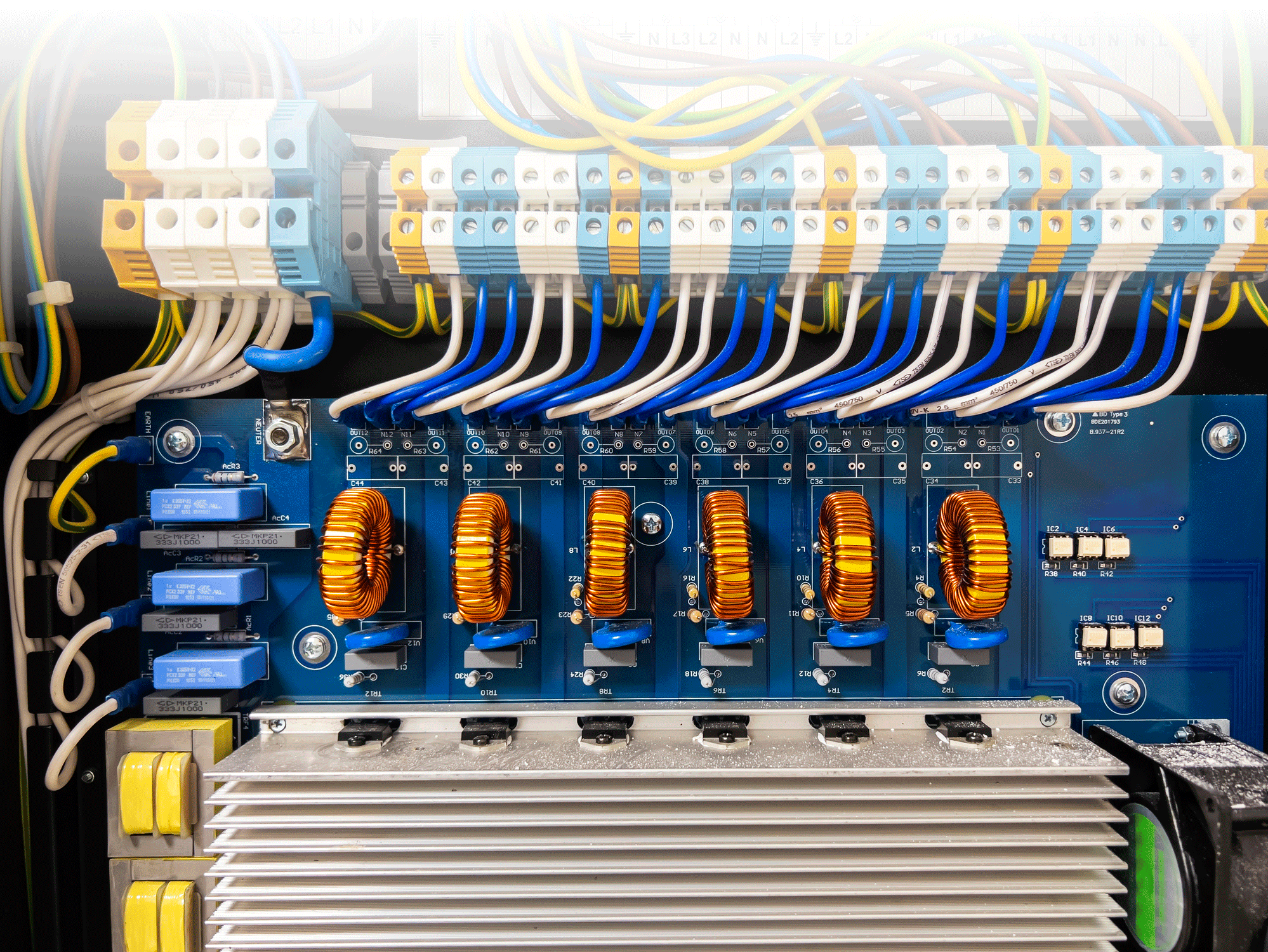
power circuitry board
Strengthen your ability to design and control modern electric drives, power electronics, and power systems.UW–Madison’s online Master of Science in Electrical and Computer Engineering: Power Engineering is designed for practicing engineers seeking advanced expertise in electric drives, power electronics, and control systems. Courses are flexible and fully online, so you can deepen your technical skills while continuing full-time professional work.

How to ApplyRequest Info

Degree awardedMaster of Science in Electrical & Computer Engineering
Credits30 graduate credits
Format100% Online, part-time
Duration2-4 Years (part-time)
Tuition$1,600/credit
StartFall / Spring
Application DeadlinesSpring: November 1 Fall: July 1

Is This Program Right for You?

Advance your expertise in electric drives, power electronics, and control systems through a rigorous, application-focused curriculum built by engineering experts. You’ll also explore emerging areas like utility-scale power electronics and computational methods for engineering. This flexible online degree supports your goals on a schedule that fits your life, whether you’re working, raising a family, or both.
  • Participate in an interactive online learning experience designed for busy professionals
  • Network with peers, faculty, and industry professionals to extend learning beyond the classroom
  • Tailor your coursework with electives in areas like advanced controls, automation, and engineering leadership
  • Learn from expert faculty at WEMPEC, a world-renowned research group in electric machines and power electronics

How to ApplyRequest Info

Our courses blend applied activities, structured opportunities for interaction, and recorded instructor materials. This intentional design supports strong engagement, clear guidance, and meaningful results.

Why This Program?

27 years

of delivering interactive online education, reflecting deep experience designing high-quality online programs for working professionals.

#11 ranking

Online Graduate Engineering Programs U.S. News & World Report, 2026

Enhance your AI skills

with an optional 9-credit graduate certificate in Artificial Intelligence for Engineering Data Analytics, available as part of your 30-credit program (no extra coursework needed).

Student Experience

Gain a strong foundation in both theory and practice as you explore topics like electric drives, power electronics, and advanced control systems. Learn to design and analyze modern power systems — and apply that knowledge to solve today’s automation and energy challenges.
  • Power electronic circuit design
  • Electric machine and drive control
  • Power system analysis and control
  • Utility applications of power electronics
  • Automation and motion control
  • System modeling and simulation
  • Applying theory to real-world challenges
 

Curriculum and Requirements

Of the 30 credits required, a minimum of 21 credits must be Electrical and Computer Engineering (E C E) courses numbered 400 and above. Of those 21 credits, at least 15 must come from the Power Engineering Course Options below, including at least 3 credits from courses numbered 500-599, and 6 credits from courses numbered 700 or above.Live course web sessions are scheduled in the evening to accommodate working professionals. All other weekly assignments can be completed on days and times of your choice. Plan for roughly 3 to 4 hours of work per credit each week. For a 3-credit course, this usually means 9 to 12 hours, depending on the course and your professional background.UW–Madison and Wisconsin Electric Machines and Power Electronics Consortium (WEMPEC) faculty have established a comprehensive curriculum in the electrical machines and power electronics field that serves students at the university, as well as engineers already established in the industry.Many courses in the Master of Science: Electrical and Computer Engineering program are taught by distinguished faculty from WEMPEC and UW–Madison’s Department of Electrical and Computer Engineering, which is recognized for excellence in research, instruction and service to the profession.
|

ECE 411 – INTRODUCTION TO ELECTRIC DRIVE SYSTEMS3 credits.Basic concepts of electric drive systems. Emphasis on system analysis and application. Topics include: dc machine control, variable frequency operation of induction and synchronous machines, unbalanced operation, scaling laws, adjustable speed drives, adjustable torque drives, coupled circuit modeling of ac machines.Requisites: (E C E 355, 356, or 377), graduate/professional standing, or member of Engineering Guest Students, or declared in Power Conversion and Control Capstone Certificate
ECE 412 – POWER ELECTRONIC CIRCUITS3 credits.Operating characteristics of power semiconductor devices such as Bipolar Junction Transistors, IGBTs, MOSFETs and Thyristors. Fundamentals of power converter circuits including dc/dc converters, phase controlled ac/dc rectifiers and dc/ac inverters. Practical issues in the design and operation of converters.Requisites: E C E 342, graduate/professional standing, member of Engineering Guest Students, or declared in Capstone Certificate in Power Conversion and Control
ECE 427 – ELECTRIC POWER SYSTEMS3 credits.The electric power industry, operation of power systems, load flow, fault calculations, economic dispatch, general technical problems of electric power networks.Requisites: E C E 330, graduate/professional standing, or member of Engineering Guest Students
ECE/ME 441 – KINEMATICS, DYNAMICS,& CONTROL OG ROBOTIC MANIPULATORS3 credits.Robotics analysis and design, focusing on the analytical fundamentals specific to robotic manipulators. Serial chain robotic manipulator forward and inverse kinematics, differential kinematics, dynamics, trajectory generation, and controls. Builds on knowledge of high-level computational programming language such as Matlab.Requisites: M E 340 and (MATH 320, 340, 341, or 375), graduate/professional standing, or member of Engineering Guest Students. Not open to students with credit for E C E 739 prior to fall 2024.
ECE 504 – ELECTRIC MACHINE & DRIVE SYSTEM LABORATORY3 credits.Steady state and dynamic performance of electric machines in combination with power electronic converters. Measurement of electric machine parameters, evaluation of synchronization techniques and inverter drive properties, realization of drive operation via real time embedded control system, implementation and comparative evaluation of advanced machine control techniques.Requisites: E C E 411, or graduate/professional standing, or declared in Capstone Certificate in Power Conversion and Control
ECE 512 – POWER ELECTRONICS LABORATORY3 credits.This laboratory introduces the student to measurement and simulation of important operating characteristics of power electronic circuits and power semiconductor devices. Emphasis is on devices, circuits, gating methods and power quality.Requisites: E C E 412, graduate/professional standing, or member of Engineering Guest Students
ECE/COPMSCI/ME 532 – MATRIX METHODS IN MACHINE LEARNING3 credits.Linear algebraic foundations of machine learning featuring real-world applications of matrix methods from classification and clustering to denoising and data analysis. Mathematical topics include: linear equations, regression, regularization, the singular value decomposition, and iterative algorithms. Machine learning topics include: the lasso, support vector machines, kernel methods, clustering, dictionary learning, neural networks, and deep learning. Previous exposure to numerical computing (e.g. Matlab, Python, Julia, R) required.Requisites: (MATH 234, 320, 340, 341, or 375) and (E C E 203, COMP SCI 200, 220, 300, 301, 302, 310, 320, or placement into COMP SCI 300), graduate/professional standing, or declared in Capstone Certificate in Computer Sciences for Professionals
ECE 711 — DYNAMICS AND CONTROL OF AC DRIVES3 credits.Principles of power converters, two axis models of AC machines and AC drives, simulation of drive systems, analytical modeling of drives, dynamic behavior of induction and synchronous motors and drive systems. Knowledge of Simulink required.Requisites: E C E 411 and (graduate/professional standing or declared in Capstone Certificate in Power Conversion and Control)
ECE 712 – SOLID STATE POWER CONVERSION3 credits.Advanced power electronics which provides an understanding of switching power converters. Included are DC-to-DC, AC-to-DC, DC-to-AC, and AC-to-AC converters, commutation techniques, converter control, interfacing converters with real sources and loads.Requisites: E C E 412 and graduate/professional standing
ECE 714 – UTILITY APPLICATION OF POWER ELECTRONICS3 credits.Power electronic application to utility systems is a rapidly growing field with major impact on the industry. Covers material on HVDC transmission, energy storage systems, renewable sources, static compensators, and flexible ac transmission systems.Requisites: E C E 412, 427, and graduate/professional standing
ME 746 – DYNAMICS OF CONTROLLED SYSTEMS3 credits.Emphasis on obtaining equations which define the behavior of physical systems frequently subjected to control; mechanical processing, fluid power, and thermal systems; analytical, experimental, and computer techniques. Knowledge of Automatic Controls [such as M E 446 or E C E 332] is required.Requisites: Graduate/professional standing
ECE/ME 732 – DYNAMICS OF CONTROLLED SYSTEMS3 credits.Emphasis on obtaining equations which define the behavior of physical systems frequently subjected to control; mechanical processing, fluid power, and thermal systems; analytical, experimental, and computer techniques. Knowledge of Automatic Controls [such as M E 446 or E C E 322] is required.Requisites: Graduate/professional standing or declared in Capstone Certificate in Power Conversion and Control. Not open to students with credit for M E 746.
ME 747 – ADVANCED COMPUTER CONTROL OF MACHINES & PROCESSES3 credits.Digital control theory, design methodology, and techniques for controller implementation on digital computers. Advanced single and multi-axis motion generation algorithms. Multiple processor control systems. Multiple objective control systems for machinery guidance and manufacturing processes. Precision control. Knowledge of digital control [such as M E 447] strongly encouraged.Requisites: M E 446 or E C E 332) and graduate/professional standing
ECE/ME 733 – ADVANCED COMPUTER CONTROL OF MACHINES & PROCESSES3 credits.Digital control theory, design methodology, and techniques for controller implementation on digital computers. Advanced single and multi-axis motion generation algorithms. Multiple processor control systems. Multiple objective control systems for machinery guidance and manufacturing processes. Precision control. Knowledge of continuous and discrete time control [such as M E 447 or E C E 332] is required.Requisites: Graduate/professional standing. Not open to students with credit for M E 747.
ME 446 – INTRODUCTION TO FEEDBACK CONTROL3 credits.Overview of linear feedback control analysis and design techniques for mechanical systems. Modeling of linear dynamic mechanical systems (review), derivation of their defining differential equations, and analysis of their response using both transient and frequency response techniques; Analysis and design of feedback control of mechanical systems using classical control transform techniques such as root locus and frequency response; Analysis of system robustness through evaluation of phase and gain margins and the Nyquist stability criterion. Design of feedback controllers for mechanical systems using frequency domain loop-shaping methods. Design domains, including mechanical, thermal, and fluid feedback control systems. Effects of non-ideal system characteristics commonly encountered in mechanical systems, such as compliance, delay, and actuator and sensor saturation. Builds on knowledge of high-level computational programming language such as Matlab or Simulink.Requisites: (M E 340 or E M A 545) and (MATH 319 or 320), graduate/professional standing, member of Engineering Guest Students, or declared in Capstone Certificate in Power Conversion and Control. Not open to students with credit for M E 346.
ME 447 – COMPUTER CONTROL OF MACHINES & PROCESSES3 credits.Discrete control theory reduced to engineering practice through a comprehensive study of discrete system modeling, system identification and digital controller design. Selected industrial processes and machines utilized as subjects on which computer control is to be implemented. Focus: computer control economics and planning as well as the control theory and programming.Requisites: M E 340, 346, or 446, graduate/professional standing, or member of Engineering Guest Students
ME/​COMPSCI/​ECE/​EMA/​EP 759 — HIGH PERFORMANCE COMPUTING FOR APPLICATIONS IN ENGINEERING3 credits.An overview of hardware and software solutions that enable the use of advanced computing in tackling computationally intensive Engineering problems. Hands-on learning promoted through programming assignments that leverage emerging hardware architectures and use parallel computing programming languages. Students are strongly encourage to have completed COMP SCI 367 or COMP SCI 400 or to have equivalent experience.Requisites: Graduate/professional standing
ECE 901 – SPECIAL TOPICS IN ELECTRICAL AND COMPUTER ENGINEERING1-3 credits.Special advanced topics across Electrical and Computer Engineering. The topics covered, instructors, and prerequisites all vary with semester and with section. Particular topics typically reflect state-of-the-art ideas and research.Requisites: Graduate/professional standing

Students in the Course Path may complete a maximum of 3 credits each of the following courses:
ECE 699 – ADVANCED INDEPENDENT STUDY1-6 credits.Directed study projects as arranged with instructor.Requisites: Consent of instructor
ECE 999 – ADVANCED INDEPENDENT STUDY1-3 credits.Directed study projects as arranged with instructor.Requisites: Consent of Instructor
Students in the Thesis or Project Path must complete a minimum of 3 credits of the following:
ECE 790 – MASTER’S RESEARCH1-9 credits.Independent work on master’s research overseen by a qualified instructor.Requisites: Declared in Electrical Engineering: Research, M.S. or Electrical Engineering: Power Engineering, M.S.
No more than 9 credits from any of the following combination:
ECE 699 – ADVANCED INDEPENDENT STUDY1-6 credits.Directed study projects as arranged with instructor.Requisites: Consent of instructor
ECE 999 – ADVANCED INDEPENDENT STUDY1-3 credits.Directed study projects as arranged with instructor.Requisites: Consent of Instructor
Students in the Thesis or Project Path must complete a minimum of 3 credits of the following:
ECE 790 – MASTER’S RESEARCH1-9 credits.Independent work on master’s research overseen by a qualified instructor.Requisites: Declared in Electrical Engineering: Research, M.S. or Electrical Engineering: Power Engineering, M.S.

Tuition and Financial Aid

$1,600 per credit payable at the beginning of each semester. Students are responsible for paying their tuition bill in full by the due date. There is no lump sum payment plan.See Tuition & Cost for more information.

Many students use a combination of employer tuition assistance, scholarships, financial aid, and payment plans to reduce out-of-pocket costs.

Click on the link/title above to explore employer reimbursement strategies, scholarship opportunities, federal aid options, and flexible payment resources for online students.

Employer Support Many students receive some financial support from their employers. Often, students find it beneficial to sit down with their employer and discuss how this program applies to their current and future responsibilities. Other key points to discuss include how participation will not interrupt your work schedule.Federal Loans Students who are U.S. citizens or permanent residents are eligible to receive some level of funding through the Federal Direct loan program. These loans are available to qualified graduate students who are taking at least four credits during the fall and spring semesters, and two credits during Summer. Private loans are also available. Learn more about financial aid.

Admissions and Events

|

All applicants must:
  • Hold a bachelor’s degree from a program accredited by ABET or the equivalent.*
  • Have a minimum undergraduate GPA of 3.0 on the last 60 semester hours of coursework.
  • Submit evidence of English language proficiency, if applicable. See the Graduate School Requirements for more information.
Ideal applicants will: * Applicants who do not hold a degree from an ABET-accredited program may still qualify. You must have:
  • A BS in science, technology, or a related field with sufficient coursework and professional experience to demonstrate engineering proficiency OR
  • At least 16 credits of college-level math and science coursework
  • If you are registered as a professional engineer by examination, include this in your application.
The admissions committee considers exceptions to standard requirements on an individual basis.

  • Online application
  • Resume/CV
  • Personal statement
  • Transcripts
  • Two letters of recommendation
For complete application details visit UW–Madison’s Guide 

Application Deadlines by Term:

Fall 2026July 1, 2026
Spring 2027November 1, 2026
Online Graduate Programs Overview Tuesday, September 8, 2026 5-5:30 PM CTJoin program staff for a conversation about our online graduate programs, including curriculum, application process and career impact.Register Now
Program Overview: Electrical & Computer Engineering: Power Engineering MS Wednesday, September 30, 2026 12-12:30 PM CTLearn about the Electrical & Computer Engineering: Power Engineering MS program including curriculum, application process and potential career paths.Register Now
Online Graduate Programs Overview Tuesday, October 13, 2026 12-12:30 PM CTJoin program staff for a conversation about our online graduate programs, including curriculum, application process and career impact.Register Now
Watch anytime on YouTube:Program Overview: Electrical & Computer Engineering Academic Program Director Steve Fredette joins Graduate Student Advisor Libby Miller to discuss the Electrical & Computer Power Engineering master’s degree and Power Conversion & Control capstone certificate.

Faculty and Staff

Steve Fredette Academic Director

Steven Fredette, Academic Director Email Steve

Libby Miller Graduate Student Advisor

Email Libby

FAQ

|

A: Yes. The MS in Electrical and Computer Engineering is 100% online and designed for working professionals.

A: Most students finish in about two to four years while working full time, typically taking 1 to 2 courses per semester.

A: Tuition is charged per credit. See Tuition & Fees for more information.

A: Yes. Courses are designed for part-time study alongside a full-time job.

A: No. The diploma awarded is a UW–Madison graduate degree and does not reference online delivery. Courses are taught and assessed under the same academic standards used across UW–Madison graduate programs. The mode of instruction does not change the credential earned.

A: Submit your application through the Graduate School. See Admissions for details or click here.

Ready to lead with confidence? Advance your career with UW–Madison’s online MS in Electrical and Computer Engineering.

How to ApplyRequest Info

Stay connected on LinkedIn Join our community of engineers, alumni, and faculty. Follow us for program news, upcoming events, and leadership insights.

Explore Similar Programs

Close-up view of a microchip, highlighting intricate circuits and components on its surface

Expand your technical knowledge of power electronics, drives, and controls with UW-Madison's online capstone certificate in Power Conversion and Control.

Data Analytics keywords banner

Gain AI and machine learning skills tailored for engineers. This flexible online capstone certificate helps you apply AI tools to real-world data challenges.
